
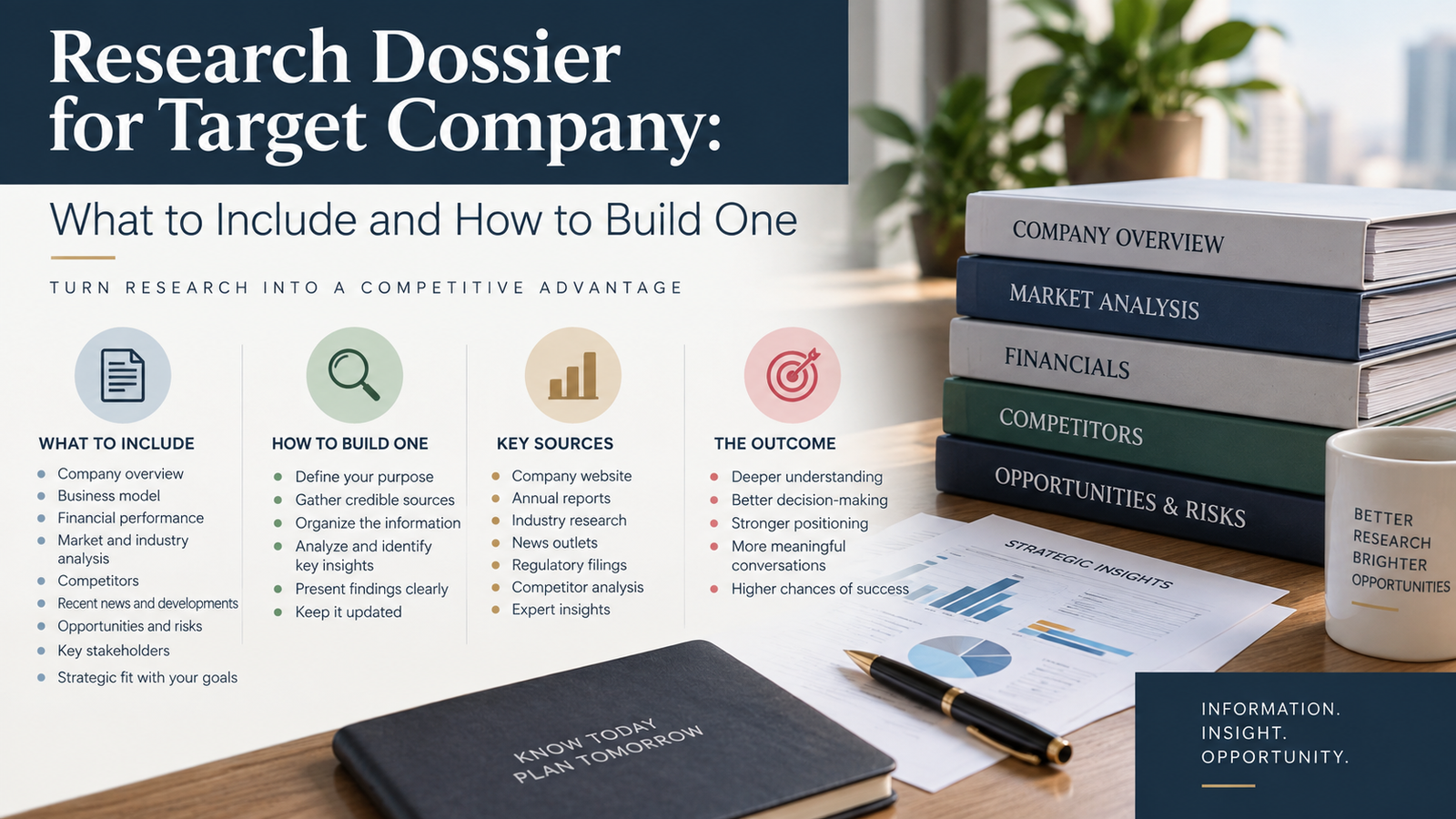
A Research Dossier for Target Company is a structured report that brings together verified information about a business, including its operations, leadership, products, financial performance, customers, competitors, market position, recent developments, opportunities, and risks. Instead of keeping useful information scattered across websites, reports, news articles, and databases, the dossier organizes it into one practical document.
The best company dossier is not simply a collection of facts. It explains what is known, identifies the evidence behind those findings, and separates verified information from estimates or interpretation. This makes the dossier useful for sales research, competitive intelligence, partnership evaluation, investment research, job preparation, supplier assessment, and other business decisions.
What Is a Research Dossier for a Target Company?
A research dossier is a detailed profile of a particular business prepared for a defined purpose. Here, the target company simply means the organization you have chosen to investigate; it does not necessarily refer to Target Corporation.
A basic company profile might contain a business name, headquarters, industry, products, and leadership team. A proper research dossier goes deeper by asking questions such as:
- How does the company make money?
- Which markets and customer groups does it serve?
- Who are its important competitors?
- What has changed recently?
- How has the business performed financially?
- What opportunities may support future growth?
- What risks or challenges deserve attention?
- Which reliable sources support these findings?
For U.S. public companies, for example, the SEC says corporate reports such as Forms 10-K, 10-Q, and 8-K can provide valuable information about financial performance and significant corporate events.
Why Build a Research Dossier?
The value of a dossier comes from turning scattered information into usable knowledge.
Imagine preparing for an important sales meeting. Knowing only what the prospect sells gives you limited context. Understanding its recent expansion, leadership changes, strategic priorities, customer segments, competitors, and business challenges can make your preparation considerably more relevant.
The same principle applies to other purposes.
A salesperson might investigate decision-makers and business priorities. An investor could concentrate on financial results, competitive advantages, and risks. A job candidate might focus on strategy, culture, leadership, products, and recent developments. A business considering a partnership may examine ownership, reputation, capabilities, market reach, and financial stability.
Therefore, the first rule of creating a Research Dossier for Target Company is simple: know why you are researching the business before deciding what information to collect.
What Should a Research Dossier for Target Company Include?
There is no universal template suitable for every situation. However, a strong dossier will usually contain the following core sections.
1. Executive Summary
Begin with a short overview that allows someone to understand the company without reading the entire report.
Include:
- Company name and industry
- Main products or services
- Primary markets
- Business model
- Major recent developments
- Important opportunities
- Significant risks
- Key conclusions from your research
Write the executive summary after completing your research, even though it appears first in the final dossier.
2. Company Overview
Create a factual snapshot of the business.
Depending on available information, record its:
- Official company name
- Website
- Founding information
- Headquarters
- Industry
- Geographic presence
- Ownership or parent organization
- Subsidiaries or important brands
- Approximate or reported workforce
- Public or private status
Be particularly careful with figures that change over time. Employee numbers, locations, executives, revenue, valuation, and market capitalization should have an associated date or reporting period.
3. Products, Services and Business Model
Knowing what a company sells is only the beginning. Try to understand how the business creates and captures value.
Ask:
Who buys its products? Is revenue generated through direct sales, subscriptions, advertising, licensing, commissions, professional services, retail transactions, or another model?
Study individual product and service pages rather than relying exclusively on the homepage. Customer case studies, pricing information, investor presentations, and product documentation can provide additional context.
Where possible, identify:
- Core products and services
- Customer segments
- Pricing or revenue model
- Sales channels
- Geographic markets
- Distribution strategy
- Important business segments
Avoid assuming that the most visible product is necessarily the company‘s biggest revenue generator.
Leadership and Ownership Research
Leadership information can help explain a company’s strategic direction.
Document key executives such as the CEO and other relevant senior leaders. Depending on your research purpose, you may also investigate board members, founders, major shareholders, or business-unit leaders.
Pay attention to recent changes. A new CEO, CFO, product leader, or board member can be more relevant than a long list of names.
When researching private businesses, ownership information can be harder to establish. Do not turn an assumption into a fact simply because multiple low-quality websites repeat it.
Financial Performance
Financial analysis should be proportional to your objective.
For public companies, useful metrics may include:
- Revenue
- Revenue growth or decline
- Operating income
- Net income or loss
- Cash flow
- Cash position
- Debt
- Capital expenditure
- Segment performance
- Geographic performance
Regulatory filings and audited annual reports should generally take priority over blogs or unsourced databases. The SEC’s EDGAR system, for example, lets researchers find filings for specific companies and provides identifying information such as the company’s CIK and fiscal year end.
Never write a financial number without understanding its period and unit. A revenue figure for fiscal 2025 should not accidentally be presented as the company’s current annual revenue in 2026.
Private companies often disclose far less financial information. In those cases, clearly label third-party numbers as estimates rather than official results.
Customers and Target Market
Next, investigate who the company serves.
A business may target individual consumers, small businesses, large enterprises, government agencies, particular industries, or several segments simultaneously.
Useful evidence can come from customer stories, case studies, product pages, investor materials, industry reports, procurement records, and publicly announced contracts.
For B2B companies, customer case studies can be especially useful because they may reveal how the product is used and which industries the company prioritizes.
Do not assume that featured customers represent the company’s entire customer base.
Competitor and Market Analysis
A Research Dossier for Target Company becomes much more valuable when the business is viewed in context.
Identify both direct and indirect competitors.
Direct competitors usually offer similar solutions to similar customers. Indirect competitors may solve the same customer problem differently.
Compare areas such as:
| Research Area | Questions to Ask |
|---|---|
| Products | What does each company offer? |
| Customers | Are they targeting the same audience? |
| Pricing | How do their pricing approaches differ? |
| Geography | Where does each business operate? |
| Distribution | How do customers buy the product? |
| Positioning | What value does each company emphasize? |
| Strengths | Where does the target appear differentiated? |
| Risks | Where could competitors apply pressure? |
Avoid declaring a company the “market leader” simply because its marketing materials use that phrase. Look for independent market evidence before making such a conclusion.
Recent News and Strategic Developments
Companies change quickly, so a dossier should include a section covering recent developments.
Look for:
- Acquisitions and divestitures
- Product launches
- Partnerships
- Funding announcements
- New executives
- Geographic expansion
- Major contracts
- Restructuring
- Regulatory developments
- New facilities
- Strategic investments
Recent information can reveal priorities that older company profiles miss. Research guidance also emphasizes checking current developments and verifying important claims instead of relying solely on a company’s own website.
Always record the date of each development.
Risks, Challenges and Opportunities
This is where research begins turning into analysis.
Potential risks could include heavy dependence on one market, intense competition, changing regulation, high debt, supply-chain exposure, technological disruption, or other company-specific factors.
Opportunities might include new geographic markets, product expansion, industry growth, partnerships, improved distribution, or emerging customer needs.
However, distinguish clearly between reported facts and your interpretation.
For example:
Fact: The company announced expansion into three additional markets.
Analysis: The expansion could increase its addressable customer base, although it may also increase operating complexity.
That distinction makes a dossier more trustworthy.

How to Build a Research Dossier Step by Step
Start by writing down your research objective and the questions the dossier needs to answer. Next, confirm the company’s exact identity, official website, legal or trading name, industry, location, and parent organization if applicable.
Then move through the research systematically.
Begin with primary sources such as the company’s official website, investor-relations pages, annual reports, regulatory filings, press releases, governance pages, careers section, and product documentation.
Afterward, cross-check material claims through independent sources such as government databases, established financial publications, credible trade publications, industry organizations, and recognized research providers. Company websites are valuable primary sources, but they represent the company’s own perspective, so independent verification improves the reliability of important conclusions.
Finally, organize your findings, analyse patterns, identify gaps, and write the executive summary.
Create an Evidence Log
One of the easiest ways to improve research quality is to maintain a source log while working.
A simple format is:
| Finding | Source | Reporting Date | Evidence Type | Status |
|---|---|---|---|---|
| Revenue | Annual report | FY ending date | Primary | Verified |
| CEO | Company leadership page | Access date | Primary | Verified |
| Market share | Industry report | Publication date | Secondary | Estimate |
| New expansion | Press release | Announcement date | Primary | Verified |
An evidence log prevents the common problem of remembering a useful fact but forgetting where it came from.
It also makes future updates significantly easier.
Separate Facts, Estimates and Analysis
Every major claim in your dossier should effectively fall into one of three categories.
Verified fact: Directly supported by credible evidence.
Estimate: A figure or conclusion supplied by a third-party source but not officially confirmed.
Analysis: Your interpretation of the evidence.
This separation is particularly important for private-company revenue, employee counts, valuations, web traffic, market share, and other figures frequently estimated by commercial databases.
Never make an estimate appear more certain by removing words such as “estimated,” “approximately,” or “according to.”
Common Mistakes to Avoid
A dossier can contain dozens of pages and still be weak if its evidence is poor. Common problems include collecting information without a defined objective, depending entirely on corporate marketing, using outdated statistics, copying numbers without reporting periods, overlooking competitors, and presenting assumptions as facts.
Another mistake is collecting everything available.
More information does not automatically create better research. Every section should help answer the question behind the dossier.
A concise 15-page document containing well-sourced, relevant evidence can be more useful than a 70-page file filled with copied company descriptions.
How to Keep the Dossier Current
A company research dossier should be treated as a living document when it supports ongoing work.
Add a last updated date and revisit information that changes frequently, particularly:
- Leadership
- Financial results
- Products
- Ownership
- Workforce
- Competitors
- Partnerships
- Acquisitions
- Legal or regulatory developments
You can also record the date each source was accessed. That makes it easier for another researcher to determine whether a finding needs to be checked again.
Conclusion
A well-built Research Dossier for Target Company turns scattered business information into a clear, evidence-based resource. Start with a specific research objective, understand the company’s operations and business model, examine leadership and financial performance, identify customers and competitors, and track important recent developments.
Most importantly, keep the dossier transparent. Record your sources, attach dates to changing information, distinguish estimates from confirmed figures, and clearly separate evidence from your own analysis. The goal is not to collect the largest possible amount of information. It is to create a reliable document that helps the reader understand the target company quickly and make better-informed decisions.
You may also read