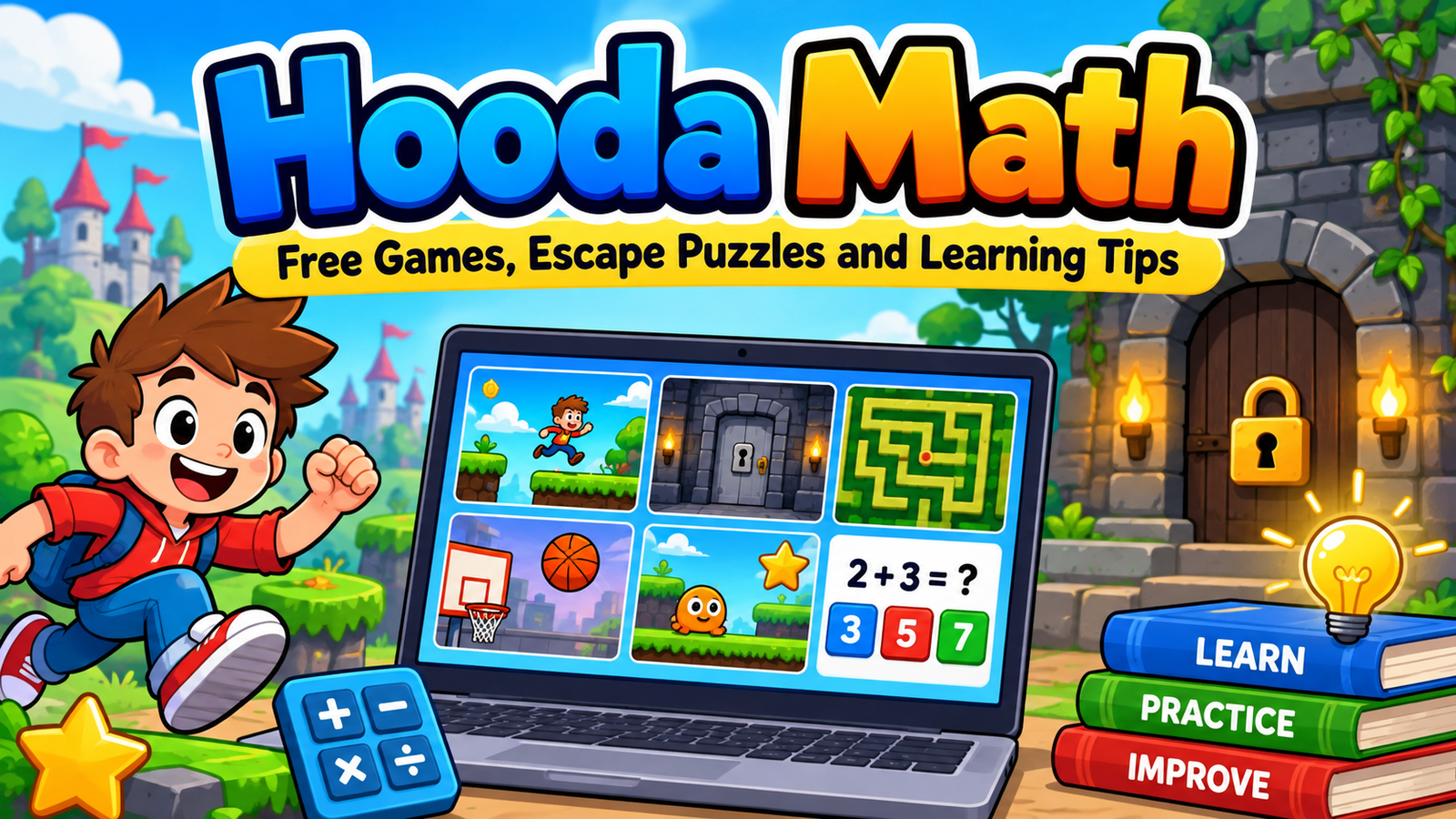
Hooda Math is a free online gaming website offering math practice, logic puzzles, escape games and other browser-based activities. You can play its web games without a required subscription or download. For focused learning, start with the math categories; for puzzle solving, explore the escape collection. Optional Club Hooda accounts provide features such as saving progress and streaks.
The main question for parents and teachers is which activities fit a learner’s needs. A multiplication game, a geometry challenge and an escape room offer different experiences. Choosing carefully helps turn a short gaming session into purposeful practice.
This guide explains what the website offers, how to get started and how to choose games that balance enjoyment with a clear learning goal.
What Is Hooda Math?
Hooda Math began in 2008, when mathematics teacher Michael Edlavitch started building online games. Google’s publisher profile describes how his classroom experience inspired the website and how advertising helped fund free access.
Today, its catalogue includes both subject-focused activities and broader entertainment. The official games directory lists arithmetic alongside escape, cooking, board, word, driving and other categories. This variety makes it useful to distinguish games that directly practise mathematics from games chosen mainly for recreation or general problem solving.
For families, that distinction makes choosing easier. If a child needs help recalling multiplication facts, start with a multiplication activity. If the goal is to discuss clues, test ideas and explain decisions, an escape puzzle may offer a better starting point.
Is Hooda Math Free?
The official website states that its browser games are free to play, with no compulsory account, download or subscription. Its homepage describes Club Hooda accounts as optional.
Free access does include advertising. Hooda Math’s privacy policy says the website uses Google AdSense and Google Analytics, and describes its advertising as contextual rather than behaviourally targeted. These are the operator’s stated practices, rather than an independent privacy assessment.
For a first visit, choose a game and read its instructions before considering optional account features. This lets you judge whether the activity suits the learner.
How to Get Started
A useful first session starts with a specific purpose:
- Open the official website:
- Choose a learning goal: For example, addition accuracy, multiplication recall or recognising transformations.
- Browse by topic or grade: Use the category that most closely matches the skill.
- Read the game instructions: Check the controls and what counts as success.
- Play one short round: Notice whether the challenge comes from the mathematics or from controlling the game.
- Review one example: Ask the learner to explain an answer or decision.
The website provides grade navigation from kindergarten through high school, alongside topic categories including fractions, integers, algebra and geometry.
For readers outside the United States, topic categories can be more useful than grade labels. School systems introduce material in different sequences, so match the activity to what the learner has already studied.
Which Hooda Math Games Should You Choose?
There is no single best game for every student. Start with the skill you want to practise, then check whether the game’s pace and controls suit the player.
The following examples appear in the official math directory:
| Learning focus | Examples to explore |
|---|---|
| Addition | Jet Ski Addition, Kitten Match Addition |
| Subtraction | Ducky Race Subtraction, Skater Math |
| Multiplication | Multiplication Game 2026, Tug Team Tractor Multiplication |
| Division | Drag Race Division, Division Derby |
| Fractions | Fractions Timed Tests, Snow Sprint Multiplying Fractions |
| Integers | Integer Tilt, Spider Match Adding Integers |
These are starting points from the catalogue, rather than a ranking of educational effectiveness.
Choose accuracy before speed
When a learner is still figuring out how an operation works, give them time to explain their method. A fast game can make it difficult to tell whether an incorrect response came from misunderstanding, rushing or pressing the wrong control.
Try asking, “How did you work that out?” If the explanation reveals confusion, pause and work through a similar example together.
Use geometry games for discussion
Transformation Golf provides a concrete example of a game with an identifiable mathematics focus. Players move a ball towards a hole using translations, rotations, reflections and dilations. Its instructions describe movement directions, rotation angles, reflection lines and scale factors.
Before making a move, ask the learner to predict where the ball will go. Afterwards, compare the result with the prediction. That discussion makes the mathematical decision more visible than simply counting completed holes.
How Do Hooda Math Escape Games Work?
Hooda Math’s escape games are point-and-click adventures. Players explore locations, collect items, inspect clues and solve puzzles to find a way out. The collection includes location-based adventures and themed titles such as Hooda Escape Math Mansion and school field-trip escapes.
These activities suit a different purpose from arithmetic drills. They give players a reason to organise information and explain why a particular clue might matter.
A useful approach is to keep a small clue log with three headings:
- Found: An item, symbol, number or message.
- Possible meaning: What it might connect to.
- Tried: An action and its result.
This can make a difficult puzzle easier to discuss. For example, if a player keeps entering the same unsuccessful code, the log provides a reminder to reconsider the underlying idea.
When helping, ask a question before revealing a solution: “Which clue have you not used yet?” or “What changed after you picked up that item?” The aim is to keep the learner involved in the reasoning.
Classroom Tools Beyond Games
The site also links to math tutorials and online manipulatives, giving teachers additional resources to explore alongside the games.
Its timed-test section offers practice in addition, subtraction, multiplication, division, fractions and integers.
Treat timed results as one piece of information. A score alone cannot explain whether a student understands a concept, misread a question or struggled with the input method.
For a more useful review:
- Look at accuracy alongside completion speed.
- Ask the student to explain a missed example.
- Revisit the same skill without a timer.
- Compare performance under similar conditions.
If a learner becomes preoccupied with the countdown, switch to a less pressured activity and return to the underlying method.
A Simple Routine for Home or School
A short session is easier to keep purposeful when it has a beginning, a task and a review. Here is a suggested 15-minute structure:
| Time | Activity |
|---|---|
| 2 minutes | Name the target skill and work through one example |
| 8 minutes | Play a selected game |
| 3 minutes | Discuss a mistake or useful strategy |
| 2 minutes | Solve a related question away from the screen |
The final question matters because game success can depend partly on familiarity with the controls. An example on paper helps you see whether the learner can use the same idea in another setting.
For paired play, one student can operate the controls while the other explains the proposed move. Switch roles regularly so both students participate.
At home, offer a choice between two suitable games. This gives the child some control while keeping the session connected to the intended skill.
What Parents Should Know About Ads and Privacy
Hooda Math’s privacy policy says the site is intended for children and teenagers under parent or teacher guidance. It also notes that links to other websites lead to services with their own content and privacy practices.
Preview the chosen activity with younger children. Check that they can identify the game area, understand the controls and recognise when a link takes them elsewhere.
Educational suitability also depends on the individual activity. A game can be enjoyable while offering little practice in the topic a child currently needs. During a preview, ask:
- What will the learner actually do repeatedly?
- Does success require the intended skill?
- Is the reading manageable?
- Can the learner explain a successful decision?
These questions are more useful than judging an activity solely by its title or category.
What Does “Hooda Math Unblocked” Mean?
The website promotes collections as “unblocked” and designed for school use. However, that description cannot guarantee access on every school network. Schools control their own filtering and device settings.
If an approved game is unavailable, ask the teacher or school IT team to check the official link.
For other loading problems, try refreshing the page, checking the internet connection or opening another game to see whether the issue affects the whole site. On a personal device, an updated browser may help. On a managed school device, leave configuration changes to the administrator.
Conclusion
Hooda Math offers an accessible way to add games and puzzles to a learning routine. Its value depends on choosing an activity with a clear purpose and checking what the learner understands afterwards. Start with one skill, select one suitable game and finish with a short discussion. That simple structure keeps the session enjoyable while giving parents and teachers something useful to observe.
You may also read