
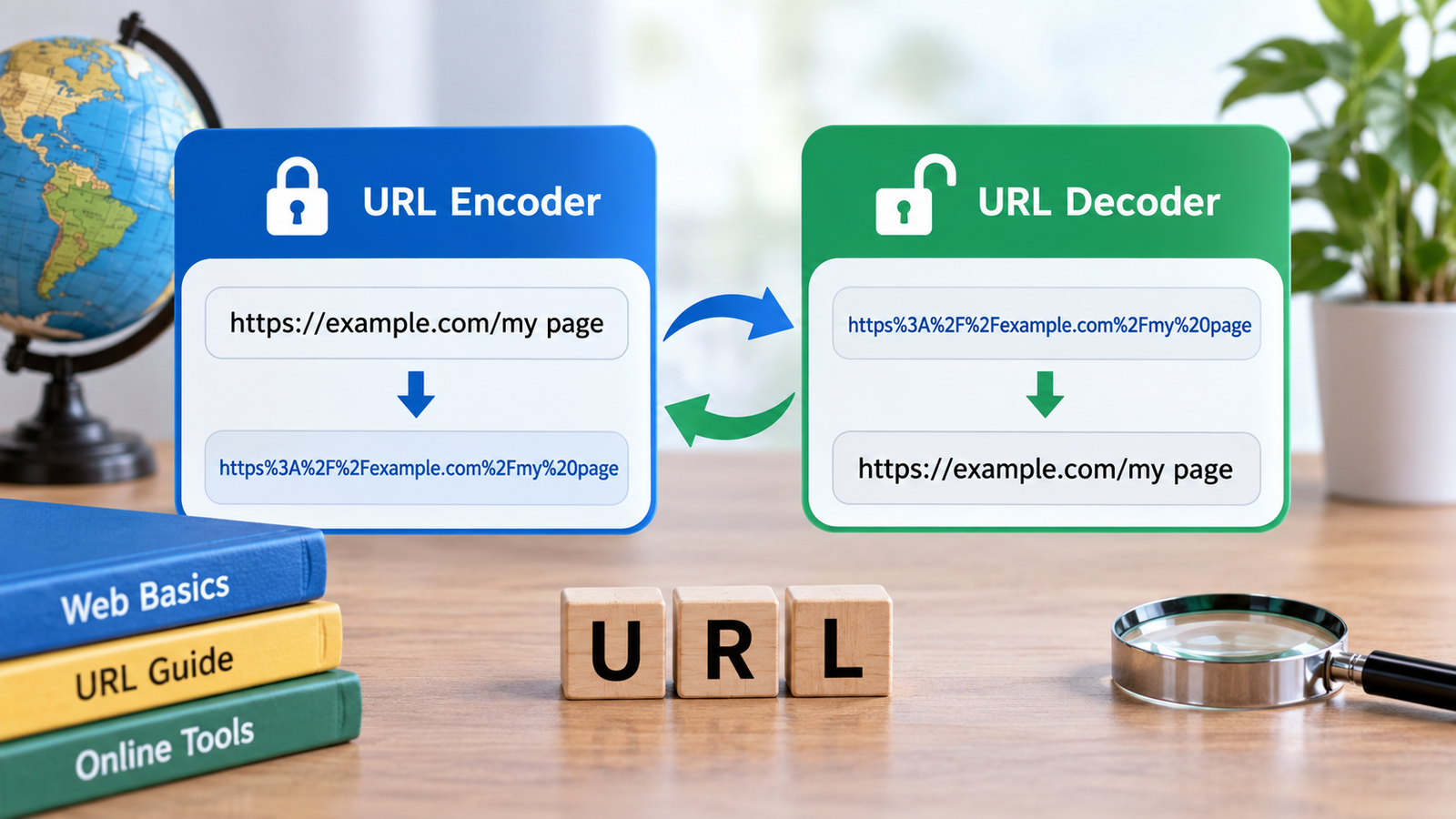
A URL encoder and decoder SpellMistake tool converts spaces, symbols, and non-English characters into a web-safe format or changes encoded text back into readable content. Paste your text or URL into the appropriate field, select Encode or Decode, and copy the result.
For example:
- Original text:
summer shoes & sandals - Encoded text:
summer%20shoes%20%26%20sandals - Decoded result:
summer shoes & sandals
This process is officially known as percent-encoding. It prevents spaces and reserved characters from changing the structure or meaning of a URL.
What Is a URL Encoder and Decoder?
A URL encoder changes characters that may not be transmitted safely inside a web address into percent-encoded values. Each encoded value normally contains a percent sign followed by two hexadecimal digits.
A URL decoder performs the reverse operation. It converts percent-encoded sequences into their original readable characters.
Common conversions include:
| Original character | Encoded value |
|---|---|
| Space | %20 |
! | %21 |
# | %23 |
% | %25 |
& | %26 |
+ | %2B |
/ | %2F |
: | %3A |
= | %3D |
? | %3F |
@ | %40 |
Suppose a website needs to place the search phrase red shoes & socks in a query parameter. The encoded value could be:
red%20shoes%20%26%20socksThe finished URL might look like this:
https://example.com/search?q=red%20shoes%20%26%20socksEncoding the ampersand is important because an unencoded & normally separates query parameters.
What Does “SpellMistake” Mean in This Search?
People searching for url encoder and decoder spellmistake are generally looking for a simple online utility or instructions for correcting URL formatting problems. “SpellMistake” may refer to a tool name, a search variation, or the need to fix incorrectly written or encoded URLs.
URL encoding does not correct ordinary spelling or grammar. Its purpose is to convert characters into a format that browsers, servers, APIs, and web applications can process correctly.
For example, an encoder will convert:
hello worldinto:
hello%20worldIt will not change a misspelled word such as helo into hello. A spell checker is needed for language corrections, while a URL encoder handles technical URL formatting.
How URL Encoding Works
URLs contain structural characters with special functions. A colon separates the scheme, slashes help define paths, a question mark introduces a query string, and an ampersand separates query parameters.
Consider this address:
https://example.com/products?category=men&color=blueIts main components are:
https— schemeexample.com— hostname/products— pathcategory=men&color=blue— query string
Problems can occur when user-supplied data contains characters that resemble URL separators. Percent-encoding distinguishes the data from the URL structure.
According to RFC 3986, a percent-encoded octet consists of % followed by two hexadecimal digits. The standard identifies letters, numbers, hyphens, periods, underscores, and tildes as unreserved characters that usually do not require encoding.
Encoding Unicode Characters
Characters outside basic ASCII are normally converted into UTF-8 bytes before percent-encoding.
For example:
cafébecomes:
caf%C3%A9The letter é requires two UTF-8 bytes, which appear as %C3%A9. The same process allows URLs to carry names, search terms, and other information written in many languages.
How to Use a URL Encoder and Decoder SpellMistake Tool
Most online encoders and decoders follow a similar process.
To Encode Text or a URL Component
- Open the encoder section of the tool.
- Paste the text, path segment, or parameter value.
- Select Encode.
- Review the converted output.
- Copy the result into the appropriate part of your URL.
Example input:
offers/summer saleExample output:
offers%2Fsummer%20saleWhether the slash should become %2F depends on context. If it is intended to separate path segments, preserve it. If it belongs inside one data value, encode it.
To Decode an Encoded Value
- Open the decoder section.
- Paste the encoded string.
- Select Decode.
- Check the readable result.
- Copy it for analysis or editing.
Example input:
customer%40example.comDecoded output:
customer@example.comOnly decode content you trust. Decoded text may reveal scripts, redirects, commands, or suspicious parameters hidden inside a long link.
When Should You Encode a URL?
Encoding is commonly needed when handling:
- Search terms containing spaces
- Query parameter values
- Email addresses passed as data
- International characters
- Form submissions
- API request parameters
- Redirect destinations
- File names containing spaces or symbols
- Tracking parameters
- Dynamically generated links
Suppose a website sends a page title as a query value:
https://example.com/share?title=News & UpdatesThis URL is ambiguous because the ampersand can be interpreted as the beginning of another parameter. The safer form is:
https://example.com/share?title=News%20%26%20UpdatesShould You Encode the Entire URL?
Usually, no. Encode the individual values or components that require protection rather than blindly encoding a complete URL.
If you encode an entire address with a component encoder, structural characters may be converted:
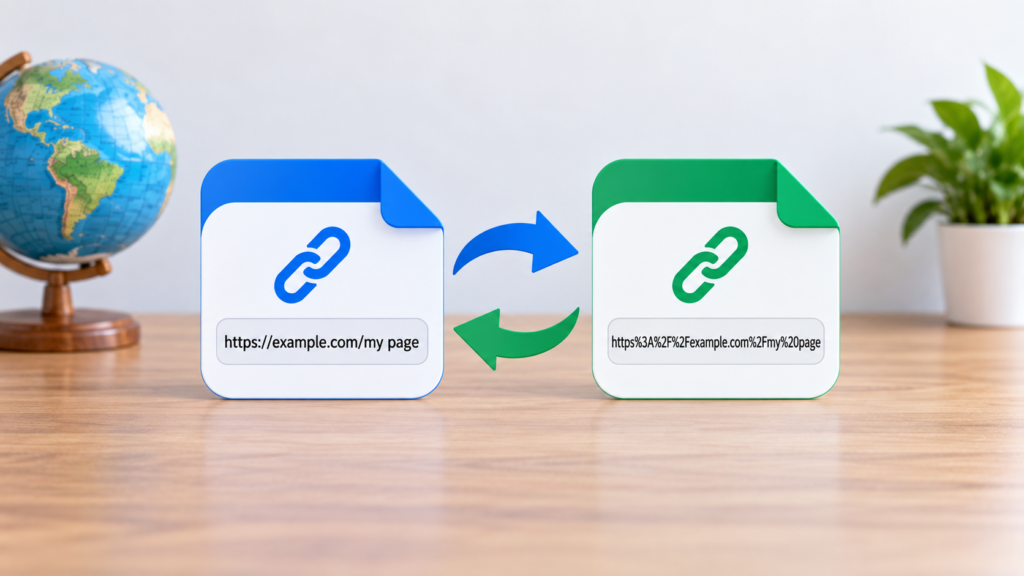
https%3A%2F%2Fexample.com%2Fproducts%3Fitem%3DblueThat result is useful only when the complete URL is being stored inside another parameter, such as a redirect value:
https://example.com/redirect?target=https%3A%2F%2Fshop.example%2FproductsWhen creating a normal clickable address, the scheme separators, path separators, and query structure must remain recognizable.
encodeURI() vs encodeURIComponent()
JavaScript provides two related functions, but they serve different purposes.
encodeURI()
Use encodeURI() when you have a largely complete URL and want to encode characters that are unsafe while preserving structural delimiters.
const url = "https://example.com/search?q=summer shoes";
console.log(encodeURI(url));
Output:
https://example.com/search?q=summer%20shoesencodeURIComponent()
Use encodeURIComponent() for an individual query value, file name, or path component. It encodes more characters, including separators such as &, =, /, and ?.
const value = "summer shoes & sandals";
console.log(encodeURIComponent(value));
Output:
summer%20shoes%20%26%20sandalsFor dynamically generated query strings, URLSearchParams is often easier and less error-prone:
const params = new URLSearchParams({
  q: "summer shoes & sandals",
  page: "2"
});

console.log(params.toString());
The result is:
q=summer+shoes+%26+sandals&page=2In form-style query serialization, spaces are commonly represented by + rather than %20.
How to Encode and Decode URLs in Python
Python provides URL-handling functions through urllib.parse.
from urllib.parse import quote, unquote

encoded = quote("summer shoes & sandals", safe="")
print(encoded)

decoded = unquote(encoded)
print(decoded)
Output:
summer%20shoes%20%26%20sandals
summer shoes & sandals
For form-style query parameters, urlencode() is convenient:
from urllib.parse import urlencode

params = {
    "q": "summer shoes & sandals",
    "page": 2
}

print(urlencode(params))
Output:
q=summer+shoes+%26+sandals&page=2Using established language libraries is preferable to manually replacing characters because the libraries handle UTF-8 and special cases more consistently.
Common URL Encoding Mistakes
Encoding a URL Twice
Double encoding occurs when already encoded text is encoded again.
First encoding:
space → %20Second encoding:
%20 → %2520The percent sign becomes %25, producing %2520. Decode only one layer at a time unless you know that the source was deliberately encoded more than once.
Confusing + With %20
Both may represent a space in certain contexts, but they are not universally interchangeable.
In application/x-www-form-urlencoded query data:
red+shoesusually means:
red shoesIn a general URL path, however, + may remain a literal plus sign. Use a parser designed for the relevant URL component.
Encoding Separators That Must Remain Structural
Encoding /, ?, &, or = can break a URL when those characters are supposed to separate components. Determine whether a character is data or part of the URL structure before encoding it.
Decoding Malformed Percent Sequences
A valid escape contains a percent sign and exactly two hexadecimal digits:
%20
%2F
%C3
Strings such as %2, %GG, or a lone % are malformed. Some decoders return an error, while others preserve or replace invalid content.
Using the Wrong Character Encoding
Modern web applications should generally use UTF-8. Encoding text under one character set and decoding it under another may produce corrupted characters.
Is URL Encoding Good for SEO?
Correctly encoded URLs support accessibility and reliable crawling, but encoding alone does not improve rankings. An excessively encoded address can also be difficult for people to understand.
For readable, SEO-friendly paths:
- Use short descriptive words.
- Separate words with hyphens.
- Avoid unnecessary parameters.
- Keep one consistent URL version.
- Encode characters only when technically necessary.
- Do not place confidential information in a URL.
- Test redirects, canonical tags, and internal links.
A clean path such as:
https://example.com/url-encoding-guideis easier to read than:
https://example.com/url%20encoding%20guidePercent-encoding makes data safe; thoughtful URL design makes addresses usable.
Security and Privacy Tips
Encoding is not encryption. Anyone can decode a percent-encoded value, so it must never be treated as a method for hiding passwords, access tokens, private messages, or personal information.
Follow these precautions:
- Do not paste sensitive data into an unfamiliar online tool.
- Use trusted local functions when working with private information.
- Validate decoded redirect URLs before opening them.
- Treat decoded input as untrusted data.
- Never execute code simply because it appeared after decoding.
- Apply output escaping and security controls separately.
A URL decoder can reveal content, but it does not determine whether that content is safe.
Conclusion
A URL encoder and decoder SpellMistake solution helps turn spaces, symbols, Unicode text, and reserved characters into a format that web systems can process reliably. Encoding replaces necessary bytes with percent-prefixed hexadecimal values, while decoding restores readable text.
For the best results, encode individual parameter values rather than complete URLs, use UTF-8, avoid double encoding, and remember that + has special meaning in form-style query strings. Developers should rely on established tools such as URLSearchParams, encodeURIComponent(), and Python’s urllib.parse instead of building replacements manually.
You may also read