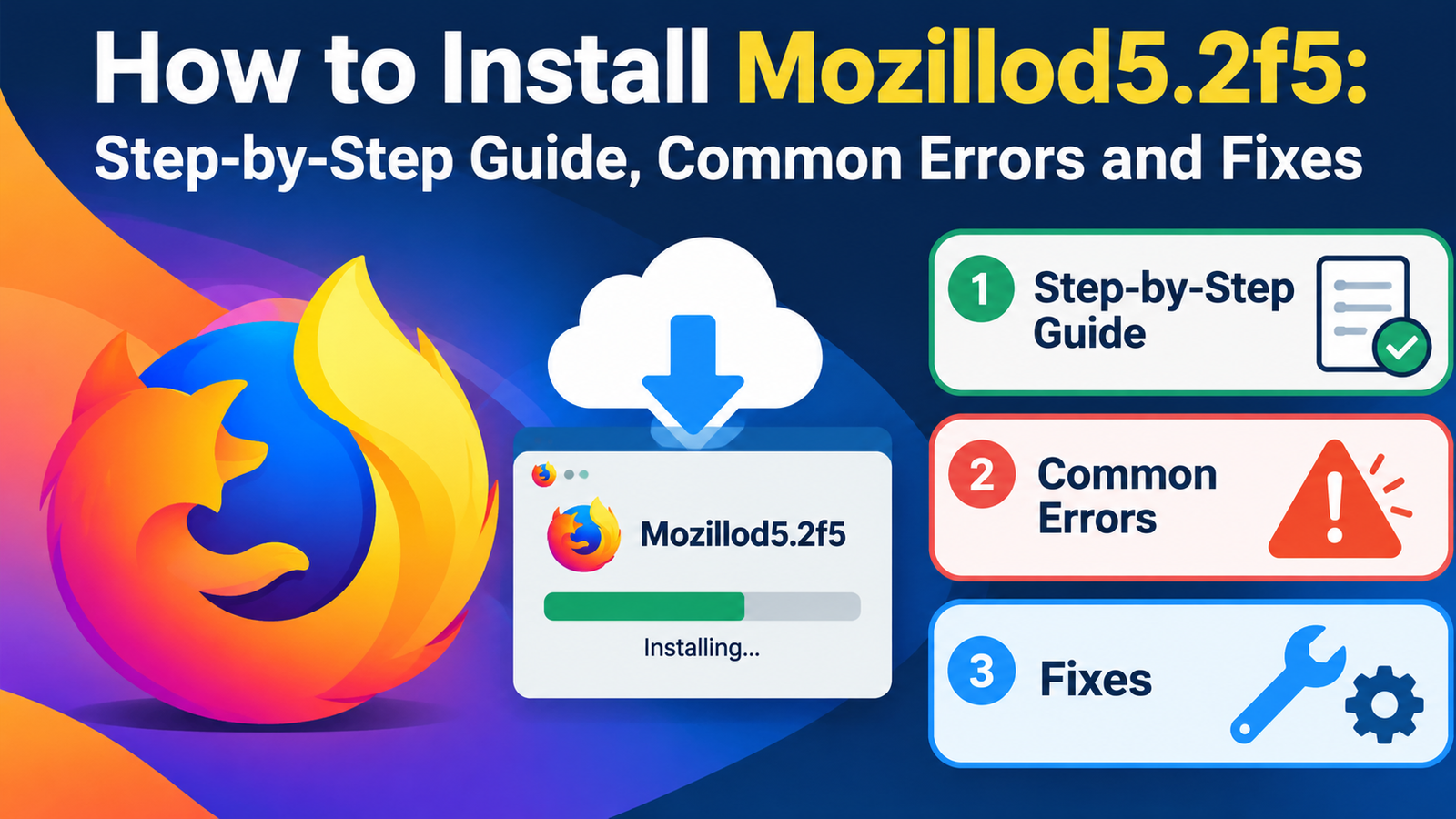
If you are searching for how to install Mozillod5.2f5, the most important first step is to verify exactly what you downloaded. As of October 2026, there is no clearly verified official Mozilla product, Firefox release, or documented Mozilla software package publicly identified as “Mozillod5.2f5.” Mozilla’s official download pages list Firefox, Firefox Beta, Developer Edition, Nightly, and ESR, but not a product with this name.
That does not automatically mean every file carrying the name is malicious. It does mean you should not treat the name as proof that the file comes from Mozilla. Before opening an installer, confirm its source, publisher, digital signature, file type, and operating-system compatibility.
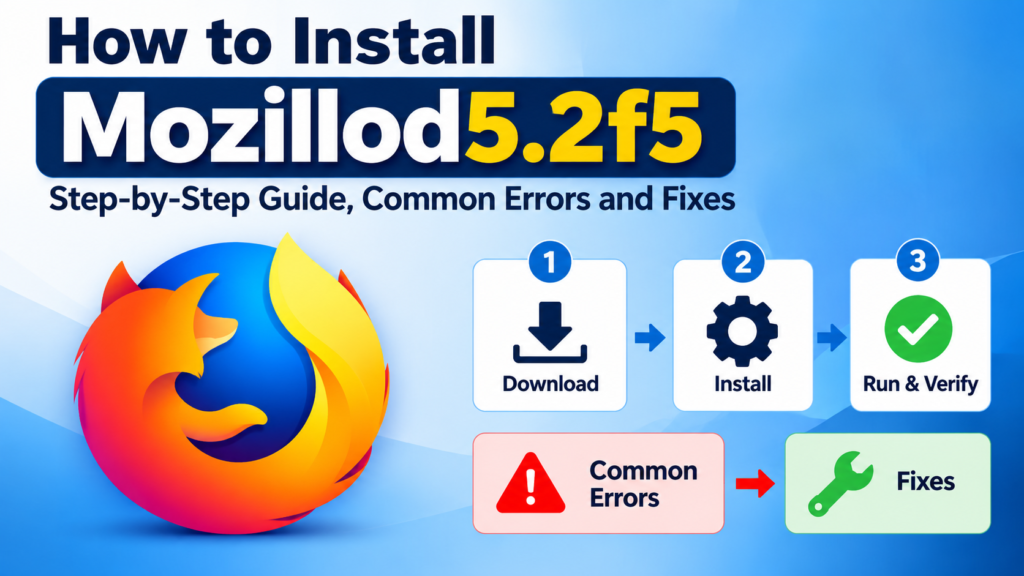
This guide explains the safest installation process, the checks to make before running the file, and practical fixes for common installation errors.
What Is Mozillod5.2f5?
The exact identity of Mozillod5.2f5 is unclear.
Several websites discuss the term as though it were a software application or browser-related package, but reliable primary documentation identifying its developer, official website, release history, system requirements, or verified download location could not be found. Some current articles acknowledge the same problem and recommend treating the software as unverified until its publisher can be confirmed.
This distinction matters because a filename containing “Mozilla” does not necessarily indicate that Mozilla created or approved it.
Official Mozilla resources currently provide documented installation methods for Firefox across Windows, macOS, and Linux.
Therefore, before you attempt to install Mozillod5.2f5, first determine whether you have:
- A legitimate third-party application
- A custom software build supplied by an organization
- An internal development package
- A renamed installer
- A corrupted or incomplete download
- A file pretending to be associated with Mozilla
Do not proceed until you understand where the file came from.
Before You Install Mozillod5.2f5
A few minutes of verification can prevent much larger problems later.
1. Confirm the Download Source
Return to the website, email, repository, company portal, or service that supplied the installer.
Look for:
- Developer or company name
- Official product page
- Release notes
- Installation documentation
- Version number
- Support information
- Privacy policy or license
- Checksum or digital signature information
Be cautious if you obtained the installer from a random download page that cannot identify the software developer.
2. Check the File Extension
The file type can tell you how the package is intended to be installed.
Common examples include:
.exe— Windows executable.msi— Windows installer package.dmg— macOS disk image.pkg— macOS installer.deb— Debian/Ubuntu Linux package.rpm— Fedora/RHEL/openSUSE package.tar.gzor.tar.xz— compressed archive.zip— compressed package
Do not rename an unfamiliar file extension simply to make it run.
3. Scan the Installer
Use your operating system’s security software to scan the downloaded file before opening it.
A security warning should be investigated rather than ignored.
If your antivirus or operating system blocks the installer, avoid immediately disabling protection. First verify who created the file and whether the warning is related to an unknown publisher, an invalid signature, or an actual malware detection.
4. Check the Digital Signature
On Windows, you can inspect many executable files by:
- Right-clicking the installer.
- Selecting Properties.
- Looking for the Digital Signatures tab.
- Checking the signer or publisher.
- Confirming that the signature is valid.
If the installer claims to come from Mozilla but the publisher does not match the organization you expected, stop the installation and investigate.
How to Install Mozillod5.2f5 Safely
Because there is no verified official installation procedure for Mozillod5.2f5, the following steps are a general method for installing a legitimate software package after you have verified its source.
Step 1: Create a Backup
Before installing unfamiliar software, save important files and make sure your operating system’s recovery features are available.
A backup is particularly useful when software installs:
- Drivers
- Browser extensions
- System services
- Startup processes
- Network components
Step 2: Close Unnecessary Applications
Close programs that could interfere with installation, particularly older versions of the same application.
You normally do not need to close every background service.
Step 3: Open the Verified Installer
Find the downloaded package in your Downloads folder.
Before running it, compare the filename, publisher, version, and file type with the information supplied by the legitimate developer.
Only continue if they match.
Step 4: Review the Permission Request
Windows may display a User Account Control prompt when software requires administrator privileges.
Read the publisher name before selecting Yes.
Do not approve the request simply because an installation tutorial tells you to do so.
An unexpected or unknown publisher is a reason to investigate further.
Step 5: Read the Installation Options
If an installation wizard appears, review every option rather than repeatedly clicking Next.
Pay attention to options involving:
- Installation directory
- Automatic startup
- Browser extensions
- Default browser changes
- Search-engine changes
- Additional software
- Network access
- Data collection
Decline optional components you do not need or recognize.
Step 6: Complete the Installation
Allow the installer to finish.
Avoid restarting or shutting down your computer while files are actively being installed.
When setup completes, close the installer.
Step 7: Launch the Program Carefully
Open the program from your application menu instead of reopening the original installer.
Check whether the program behaves normally.
Look for an About, Help, or Version page and compare the displayed information with the software you intended to install.
Installing on Windows
If your verified Mozillod5.2f5 package is a Windows .exe or .msi installer, the normal process is:
- Locate the installer.
- Scan it with Windows Security or your trusted security software.
- Check its publisher and digital signature.
- Double-click the installer.
- Approve administrator access only when justified.
- Review installation settings.
- Complete setup.
- Launch the application.
For comparison, Mozilla’s official Firefox installation documentation tells Windows users to obtain Firefox from Mozilla’s download service and follow the installer supplied by Mozilla.
If your goal was actually to install Firefox rather than Mozillod5.2f5, use Mozilla’s documented download instead of an unfamiliar installer.
Installing on macOS
If the verified package is a .dmg or .pkg, macOS normally handles installation differently from Windows.
For a legitimate application you would generally:
- Open the downloaded package.
- Confirm the developer when macOS displays security information.
- Follow the official installation instructions.
- Move the application into the Applications folder when required.
- Launch it from Applications.
Do not bypass macOS security warnings simply because the application is not opening.
If macOS reports that the developer cannot be verified, confirm the software’s authenticity first.
Installing on Linux
Do not copy random terminal commands from unrelated tutorials.
The correct Linux installation method depends on the actual package format and software developer.
For example, official Firefox installations can use Mozilla’s package repository, distribution package managers, Flatpak, Snap, or Mozilla’s official tarball builds. Mozilla documents those methods directly.
An unknown archive named Mozillod5.2f5 should not automatically be given root access with a command such as:
sudo ./install.sh
Using sudo allows software to make system-level changes.
Only follow commands supplied by a verified developer whose package you trust.
Common Mozillod5.2f5 Installation Errors and Fixes
Installer Will Not Open
Possible causes include:
- Corrupted download
- Unsupported file format
- Security blocking
- Incomplete download
- Wrong operating-system version
Fix: Delete the incomplete file and obtain a fresh copy from the verified source. Scan it again before opening.
Do not keep trying alternative unofficial download sites.
“Unknown Publisher” Warning
An unknown-publisher warning means your operating system cannot establish a trusted identity for the software publisher.
It does not automatically prove the software is malware, but it removes an important layer of verification.
Fix: Check:
- Official developer documentation
- Digital signature
- File hash
- Original download domain
- Release documentation
If you cannot establish who created the software, cancel installation.
Administrator Permission Required
Some legitimate applications require elevated privileges.
However, administrator access gives software significantly more control over the system.
Fix: Confirm that the installer genuinely requires elevated access and that its publisher has been verified. Then run it using the approved method supplied by the developer.
Do not grant administrator privileges merely to bypass an unexplained error.
Installation Freezes
A setup process may freeze because of:
- Insufficient disk space
- Damaged installer
- Existing version conflict
- Missing dependency
- Background software conflict
- Unsupported operating system
Fix:
- Close the installer.
- Restart the computer.
- Check available storage.
- Confirm OS compatibility.
- Re-download the installer from the original trusted source.
- Try again.
If the installer repeatedly freezes at the same point, stop rather than repeatedly forcing the installation.
“This App Can’t Run on Your PC”
This usually indicates a compatibility problem.
You may have downloaded:
- A 64-bit package for an unsupported system
- An ARM version for an x86 device
- An installer requiring a newer OS
- A corrupted executable
Fix: Verify your operating-system architecture and download the correct build from the developer.
Antivirus Blocks Mozillod5.2f5
Do not automatically disable your antivirus.
Security tools may block files because they are:
- Known malware
- Suspicious
- Unsigned
- Rare or unfamiliar
- Modified after signing
First determine exactly why the software was blocked.
If you cannot verify the file independently, deleting it is safer than disabling your security controls.
Installation Finishes but the Program Will Not Open
If setup appears successful but Mozillod5.2f5 will not launch:
- Restart your computer
- Check for error messages
- Verify the installed program path
- Review operating-system logs if you know how
- Confirm required dependencies
- Recheck compatibility
- Reinstall only from the verified source
Avoid downloading random DLL files or system components from third-party websites to fix missing-file errors.
How to Check Whether Mozillod5.2f5 Installed Correctly
After installation, verify several things.
Check the Application List
Confirm that the application appears in your operating system’s installed-program list.
Check the Version
Open the application’s About or Help screen.
The program name, version, and developer should match the package you expected.
Check Startup Items
Make sure the installation did not add unexpected startup programs.
Check Browser Extensions
If the software interacts with browsers, inspect your extensions or add-ons.
Remove anything you did not intentionally approve.
Monitor Unexpected Changes
Watch for unusual behavior such as:
- New search engines
- Changed homepage
- Pop-ups
- Unexpected network activity
- New toolbars
- Unknown startup processes
- Security warnings
If these appear after installing an unknown package, uninstall it and run a security scan.
Is Mozillod5.2f5 an Official Mozilla Release?
There is currently no reliable evidence in Mozilla’s publicly available product and Firefox installation resources identifying Mozillod5.2f5 as an official Mozilla release.
Mozilla currently documents Firefox, Firefox Beta, Developer Edition, Nightly, and Firefox ESR among its desktop browser choices.
For that reason, users should avoid calling Mozillod5.2f5 a Mozilla browser, Firefox version, official patch, or Mozilla utility unless reliable primary documentation proves that relationship.
This is important for both safety and accuracy.
What If You Actually Wanted Mozilla Firefox?
If your intention was simply to install Mozilla Firefox, you do not need Mozillod5.2f5.
Mozilla provides its official Firefox download directly and maintains separate installation documentation for supported platforms.
Official Firefox installation options include Windows, macOS, Linux, and several Firefox release channels.
Using the official installer is safer than searching for unfamiliar packages with Mozilla-like names.
Conclusion
Anyone searching for install Mozillod5.2f5 should focus first on verification rather than rushing to run an installer. The software name currently lacks the clear official documentation, developer identity, verified download location, and release history normally expected from established applications.
If you already have the file, verify its source, publisher, digital signature, operating-system compatibility, and security scan results before opening it. Never disable security protections or run unknown installation scripts simply to make setup work.
And if you were actually trying to install Mozilla Firefox, use Mozilla’s official download and installation documentation instead. That provides a known publisher, documented versions, supported platforms, and a far more reliable installation path.
You may also read