
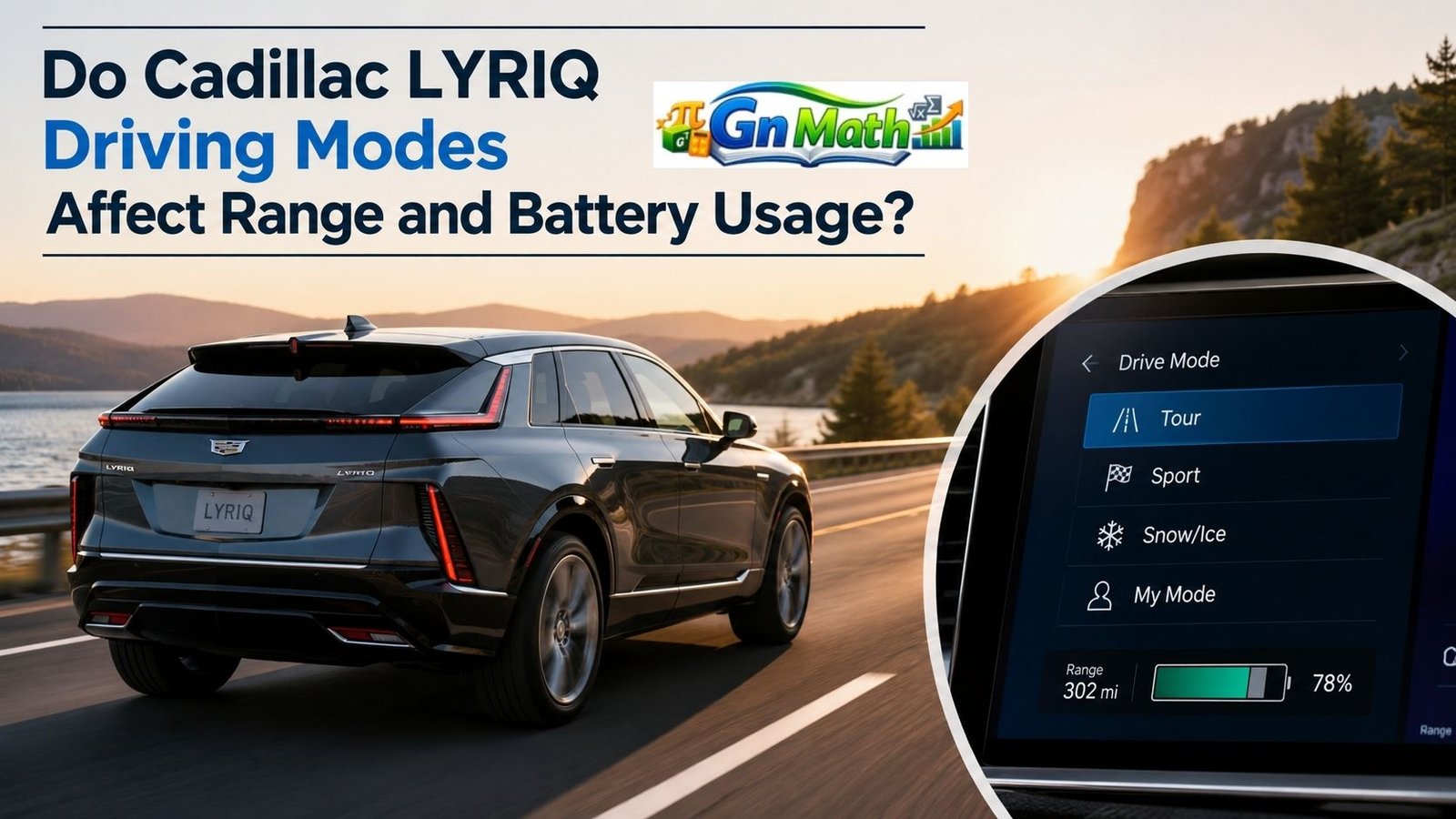
Do the driving modes in Cadillac LYRIQ offer different ranges or battery usages? Yes but indirectly. The LYRIQ does not receive a separate official range rating for Tour, Sport, Snow/Ice or My Mode. Selecting a mode also does not change the battery’s physical capacity. However, each mode changes aspects of the vehicle’s response, which can influence how much energy it consumes in real-world driving.
Tour generally encourages smoother everyday driving, while Sport provides sharper responses that may lead to higher energy consumption if the driver accelerates aggressively. Snow/Ice modifies accelerator and torque response to improve traction rather than maximize efficiency. My Mode can be efficient or energy-intensive depending on how it is configured and driven.
The practical difference therefore depends more on driver behavior, speed, weather and road conditions than on the selected mode alone.
How Cadillac LYRIQ Driving Modes Work
Cadillac’s Driver Mode Control changes the behavior of certain vehicle systems according to road conditions and driver preferences. Available modes can vary by model year, equipment and market, but standard LYRIQ models commonly include Tour, Sport, Snow/Ice and My Mode.
These modes may adjust:
- Accelerator-pedal response
- Steering feel
- Braking responsiveness
- Traction-control behavior
- Motor sound
- Other handling characteristics, depending on equipment
They do not install a different battery map with a guaranteed number of miles or kilometres. Instead, their effect on range comes from how the revised settings influence acceleration, speed control and the driver’s inputs.
Cadillac LYRIQ Driving Modes and Their Range Effects
| Driving mode | Main purpose | Likely effect on battery usage |
|---|---|---|
| Tour | Smooth, comfortable everyday driving | Usually the most predictable choice for efficient driving |
| Sport | Sharper response and sportier handling | May consume more energy when used with rapid acceleration or higher speeds |
| Snow/Ice | Controlled torque delivery on slippery surfaces | No fixed efficiency benefit; cold weather usually reduces range |
| My Mode | Personalized acceleration, steering, braking and sound | Depends on selected settings and driving behavior |
| V-Mode or performance settings | Maximum performance on applicable LYRIQ-V models | Can increase consumption when the added performance is used |
Tour Mode
Tour is the normal everyday mode. Cadillac describes it as providing normal acceleration and comfortable ride tuning. Its smoother accelerator response can make it easier to avoid sudden power demands and maintain a steady pace.
Tour does not function as a dedicated “Eco” mode, however. It will not automatically guarantee maximum range if the driver travels at high speeds, repeatedly accelerates hard or uses substantial cabin heating.
For most owners seeking predictable efficiency, Tour is the best starting point because its calibration supports calm, progressive driving.
Sport Mode
Sport makes the LYRIQ feel more responsive. Depending on the vehicle’s equipment, it may sharpen accelerator and steering response and change other handling settings.
The mode itself does not continuously draw a large amount of extra electricity. If a driver selects Sport but maintains the same moderate speed and smooth acceleration used in Tour, the difference may be small.
Battery consumption can rise when the sharper response encourages:
- Harder acceleration
- Frequent changes in speed
- Higher cruising speeds
- More performance-focused driving
- Repeated use of the vehicle’s maximum power
Rapid acceleration requires high power from the battery. Although accelerating hard for a few seconds will not destroy the LYRIQ’s range, repeating it throughout a journey can noticeably increase average energy consumption.
Snow/Ice Mode
Snow/Ice mode is intended for control and traction, not maximum range. Cadillac states that it changes the pedal map by slowing acceleration and torque response to help prevent wheel slip on slippery surfaces.
Its gentler torque delivery might reduce wasteful wheelspin, but that does not make it an economy mode. The conditions that require Snow/Ice—low temperatures, snow, slush and wet roads can independently increase energy consumption.
Cold weather affects EV range because:
- Cabin heating uses battery energy
- Cold battery chemistry can reduce available performance
- Snow and standing water increase rolling resistance
- Winter tires may have higher rolling resistance
- Low tire pressure increases drag
- Battery conditioning consumes electricity
The U.S. Department of Energy notes that battery-electric vehicles are particularly sensitive to cold conditions because of HVAC demand and changes in battery performance. Therefore, a lower winter range should not automatically be blamed on Snow/Ice mode.
Cadillac also advises against using One-Pedal Driving on wet, snowy or icy roads. Drivers should follow the vehicle’s recommendations and prioritize safe control over minor efficiency gains.
My Mode
My Mode allows the driver to personalize characteristics such as acceleration feel, steering, braking response and motor sound. Consequently, it has no single effect on battery usage.
A My Mode configuration with smooth accelerator response may support efficient driving. A more aggressive acceleration setting could make additional energy consumption more likely. Motor sound and steering settings generally have much less influence on range than acceleration, speed and climate control.
The driver’s inputs remain decisive. A responsive setting does not force the vehicle to use maximum power; it simply makes that power easier to request.
Does Changing Modes Alter the LYRIQ’s Official Range?
No. Official range ratings apply to a particular vehicle configuration, not to each selectable driving mode.
Cadillac’s U.S. specifications list up to 326 miles of EPA-estimated range for current rear-wheel-drive LYRIQ models and up to 319 miles for certain all-wheel-drive versions. Those figures can vary by model year, drivetrain, charging hardware, wheels and performance configuration. International ratings may also differ because testing procedures are not identical worldwide.
These configuration-based differences should not be confused with drive-mode effects. Rear-wheel drive versus all-wheel drive, for example, is a physical powertrain difference. Switching from Tour to Sport is a software-controlled change in vehicle response.
The LYRIQ-V is another distinct vehicle configuration. Its performance hardware and available Velocity Max capability should not be compared with selecting Sport in a standard LYRIQ.
Why the Estimated Range Can Change While Driving
The range shown on an EV’s display is an estimate, not a fixed promise. It responds to energy use and operating conditions.
A driver may select Sport, accelerate repeatedly and then see the projected range decline more quickly. That does not mean Sport contains a programmed range penalty. It means recent consumption suggests that the remaining battery energy will cover fewer miles if the same pattern continues.
Conversely, smooth urban driving in moderate weather may produce better efficiency and a more favorable range projection.
Cadillac says actual EV range can vary according to outside temperature, terrain, vehicle load and driving technique. Other important factors include:
- Highway speed
- Headwinds
- Elevation changes
- Heating and air-conditioning use
- Tire pressure and wheel size
- Passenger and cargo weight
- Battery temperature and condition
- Towing
- Frequent rapid acceleration
In many situations, these variables have a greater effect than the selected drive mode.
One-Pedal Driving, Regeneration and Range
One-Pedal Driving and Regen On Demand are related to efficiency, but they are not the same as Tour, Sport or Snow/Ice mode.
One-Pedal Driving allows the vehicle to slow down—and under normal conditions stop—when the driver lifts off the accelerator. Cadillac offers different deceleration levels on supported vehicles. Regen On Demand uses the steering-wheel paddle to increase regenerative deceleration.
During regenerative braking, the electric motors act as generators. They convert part of the vehicle’s kinetic energy into electricity and return it to the battery.
Regeneration can be particularly useful in:
- Stop-and-go traffic
- Urban driving
- Gradual downhill sections
- Routes with frequent controlled deceleration
It cannot recover all the energy used to accelerate. Energy is always lost through aerodynamic drag, rolling resistance, electrical conversion and other processes. Smooth driving that avoids unnecessary acceleration and braking remains more efficient than repeatedly using power and then trying to recover it.
Regenerative braking can also be limited when the battery is very cold, very hot or close to full. The brake pedal must always be used when additional or emergency stopping force is required.
How to Maximize Cadillac LYRIQ Range
Drivers seeking the longest practical range should focus on the following habits:
Use Tour for Normal Driving
Tour offers a smooth, predictable response suitable for most journeys. It makes efficient accelerator control easier without compromising ordinary performance.
Maintain a Steady Speed
Aerodynamic resistance rises rapidly with speed. Moderate highway speeds can make a larger range difference than switching between Tour and Sport.
Accelerate Progressively
The LYRIQ’s immediate torque makes strong acceleration tempting, but gentle starts usually consume less energy.
Precondition While Plugged In
Heating or cooling the cabin before departure while the vehicle remains connected allows more battery energy to be reserved for driving.
Use Climate Control Thoughtfully
Seat heating or ventilation may require less energy than aggressively heating or cooling the entire cabin, depending on conditions and equipment.
Check Tire Pressure
Underinflated tires increase rolling resistance. Use the pressure specified by Cadillac rather than inflating beyond the recommended level.
Use Regeneration Appropriately
One-Pedal Driving or Regen On Demand can reduce reliance on friction brakes in suitable conditions. Avoid One-Pedal Driving on slippery roads when Cadillac recommends against it.
Plan for Weather and Elevation
Allow an additional range buffer during very cold weather, strong winds, mountain driving or heavy rain.
How to Compare the Modes Accurately
Owners who want to measure the difference should examine average energy consumption rather than relying only on the dashboard’s changing range number.
For a useful comparison:
- Drive the same route in similar traffic and weather.
- Begin with a similar battery state of charge and battery temperature.
- Use the same climate settings, speed and passenger load.
- Reset the trip-efficiency display before each test.
- Compare energy consumption in kWh per 100 miles or kWh per 100 kilometres.
- Repeat the test to reduce the effect of wind, traffic and elevation.
A lower kWh-per-distance figure indicates better efficiency. Testing over several journeys provides more meaningful results than comparing two short trips.
Conclusion
The Cadillac LYRIQ’s driving modes can affect real-world battery usage, but they do not provide separate fixed ranges or alter the battery’s physical capacity. Tour is usually the most sensible choice for smooth, efficient daily driving. Sport may increase consumption when its sharper response encourages aggressive acceleration, while Snow/Ice prioritizes traction in conditions that often reduce EV range independently. My Mode’s effect depends on its configuration and the driver.
The largest range differences usually come from speed, temperature, cabin heating, terrain, tires and driving technique. Select the mode that suits the road conditions, then drive smoothly and monitor actual energy consumption for the clearest picture of efficiency.
You may also read