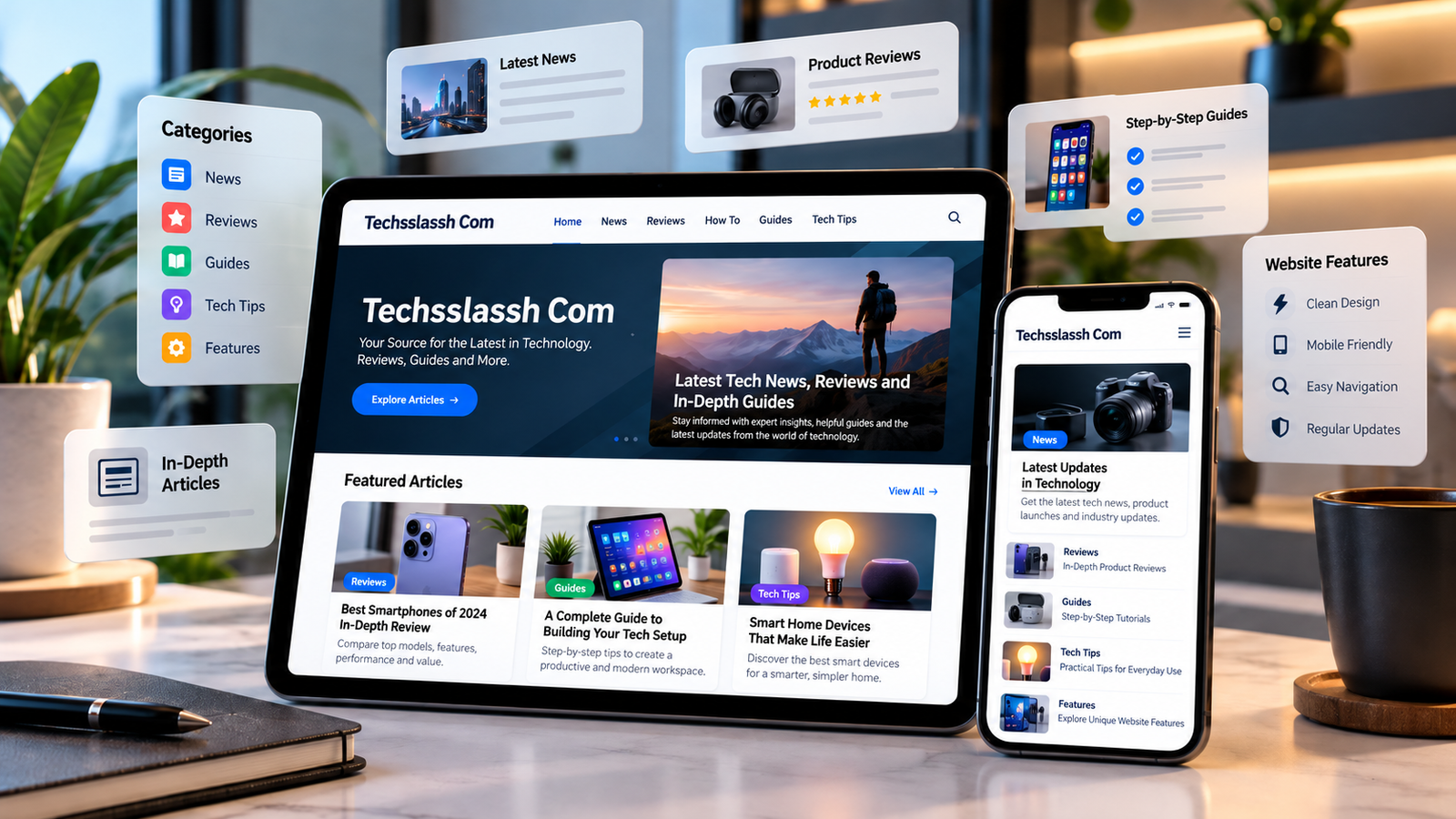
Techsslassh Com is a general-interest publishing website covering technology, business, entertainment, social media, and other topics. Its public pages combine informational articles, practical guides, and commercially focused content. Although its name suggests a dedicated technology publication, its coverage extends well beyond tech.
For readers, the main questions are straightforward: what can you find there, how easy is it to explore, and how much confidence should you place in its articles? This guide examines the website’s visible features and publishing disclosures, separating what the site actually displays from claims that would require independent verification.
The observations below reflect pages reviewed on 8 October 2026. Content, navigation, and policies can change.
What Is Techsslassh Com?
The website’s About Us page describes it as a platform for technology, news, gaming, and daily updates. Its broader description also mentions finance, entertainment, lifestyle, health, and fitness. This makes it closer to a mixed-topic online magazine than a narrowly focused technical resource.
That distinction helps set expectations. Someone looking for an introductory explanation or a topic to explore may find relevant material. Someone needing detailed product testing, original reporting, or specialist guidance should assess the individual article’s evidence.
A publication’s description tells you what it intends to cover. The quality of a particular page depends on more specific factors: who wrote it, when it was updated, which sources it uses, and whether its conclusions follow from those sources.
Check the Exact Website Address
The domain examined here is techsslassh.com. Its own pages sometimes use different spellings of the name, including “Techsslash,” and the affiliate disclosure references a differently spelled domain. Those inconsistencies do not establish that similarly named websites share ownership.
When returning to an article, use its exact address or a bookmark. This avoids confusion between a website, a similarly named publication, and a separate page discussing that publication.
What Content Does the Website Cover?
The navigation includes the following sections and subsections. Their presence indicates how the site organizes content; it does not guarantee equal depth or publishing frequency across every category.
| Main section | Visible categories or subsections |
|---|---|
| Technology | Gadgets, Digital Marketing, Internet |
| Guide | Tech Guide, Home Improvement |
| Business | Cryptocurrency, Financial Glossary |
| Entertainment | Lifestyle |
| Other sections | News, Education, Games, Instagram followers |
Technology and Digital Business
The Technology archive contains articles about mobile application security, business software, equipment manuals, social media marketing, and online content strategy. It also includes casino-related material and other subjects that stretch beyond a conventional technology category.
This broad organization means that an article’s headline and introduction may be more useful than its category label when deciding whether to read it.
For example, a reader interested in software should check whether a page explains a specific product, discusses a general business problem, or promotes an external service. Those are different kinds of content, even when they appear in the same archive.
Practical Guides
One reviewed article discusses recovering material from the Wayback Machine. It uses section headings and lists to cover capture dates, missing resources, and the limitations of archived websites. It also links to an external recovery service. This provides a concrete example of the site’s explanatory guide format.
A useful way to assess any such guide is to ask whether it provides enough detail to complete the task. An overview can explain the problem clearly while still leaving readers needing official documentation or more precise instructions.
Main Features and Reading Experience
Category Archives and Search
The reviewed pages display a search field, while the Technology archive provides numbered pages for browsing older entries. These features offer routes beyond the homepage when looking for a particular subject.
Start with a specific phrase, such as the software name or the problem you want to solve. A narrow query is usually easier to evaluate than a broad term like “technology.”
If the internal results are unhelpful, an external search can be limited to the domain:
site:techsslassh.com your topic
Author Names, Dates, and Reading Estimates
The reviewed Wayback Machine article displays an author label, publication date, comment indicator, and estimated reading time. Its body is divided into short sections. These details help readers judge relevance and navigate the page, although an author label alone does not establish subject expertise.
Dates deserve particular attention in tutorials. Before following instructions, compare the article’s screenshots, menu names, and software references with what you currently see.
Subscription and Contact Options
Public pages show an email subscription form. However, its description references “FooBar” and art, design, and business, suggesting that some template wording remains. The form’s presence does not confirm newsletter delivery or frequency.
A separate contact page provides a name, email, and message form. It also lists contact details, but the availability of those fields does not establish how quickly inquiries receive a response.

Publishing Disclosures Readers Should Understand
Affiliate Links and Sponsored Content
The affiliate disclosure says purchases through certain links may generate compensation. It also says sponsored content would be identified at the beginning of a post. However, the page contains inconsistent domain references and wording that first says the author does not write sponsored posts before discussing their possible publication.
The practical point is to inspect each article’s disclosures and destinations. A link may lead to a seller, service provider, or other commercial website.
Affiliate funding does not automatically make an article inaccurate. It does make the reasoning behind a recommendation worth examining: are there clear comparison criteria, meaningful drawbacks, and evidence of actual use?
Paid Authorship and Content Checks
A notice visible on reviewed pages states that paid authorship is permitted and daily content checks are not guaranteed. This is relevant when deciding how much editorial oversight to assume. It does not prove that a particular article is paid or incorrect.
Assess articles individually. Strong evidence includes links to original announcements, identifiable expertise, specific examples, and explanations that distinguish confirmed facts from promotional claims.
How Reliable Is Techsslassh Com?
There is insufficient evidence from the reviewed pages to give the entire website a blanket reliability rating. Its disclaimer describes the material as general information and does not guarantee completeness, reliability, or accuracy. It also explains that external websites operate beyond its control.
A more useful approach is to match your verification effort to the claim:
- For a basic explanation: Check whether the article defines terms clearly and provides relevant examples.
- For a product recommendation: Look for testing details, limitations, and current specifications.
- For a news claim: Follow the original announcement or reporting.
- For a technical procedure: Compare the steps with the product’s official documentation.
The site’s Technology archive includes commercial and earnings-oriented headlines alongside informational subjects. Their appearance is evidence of the content mix, not verification of the offers or claims they describe.
Privacy and External Links
The privacy policy discusses comments, cookies, embedded content, and data retention. Several sections still begin with “Suggested text,” indicating that template language remains visible. That limits how confidently readers can treat it as a fully customized description of the website’s practices.
Before submitting information, consider what the interaction requires. A general inquiry normally needs a message and a reply address; unrelated personal details add little value.
External links deserve a separate assessment. The website’s disclaimer acknowledges that linked destinations can have different terms and privacy policies. Reading an article and signing up with a service mentioned in it are distinct decisions.
How to Get the Most Value From the Site
Use a simple reading process:
- Define your question. Decide what information you need before browsing.
- Select the relevant page. Judge the headline and introduction, not just its category.
- Check timing and authorship. Establish whether the article fits your situation.
- Examine supporting evidence. Open original sources when the conclusion matters.
- Separate explanation from promotion. Notice disclosures and commercial destinations.
For example, if you want help with a software feature, look for the exact version and a usable sequence of steps. If the article only introduces the feature, treat it as background and continue to the official help pages.
This approach makes a broad publication more useful without assuming that every article has the same purpose or standard.
Conclusion
Techsslassh Com offers a broad collection of articles with familiar browsing features. Its mixed subject matter and publishing disclosures make article-level evaluation essential. Use it to discover topics, then check the evidence behind information that affects a practical decision. Start with a relevant article and follow its strongest claims back to their original sources.
You may also read