
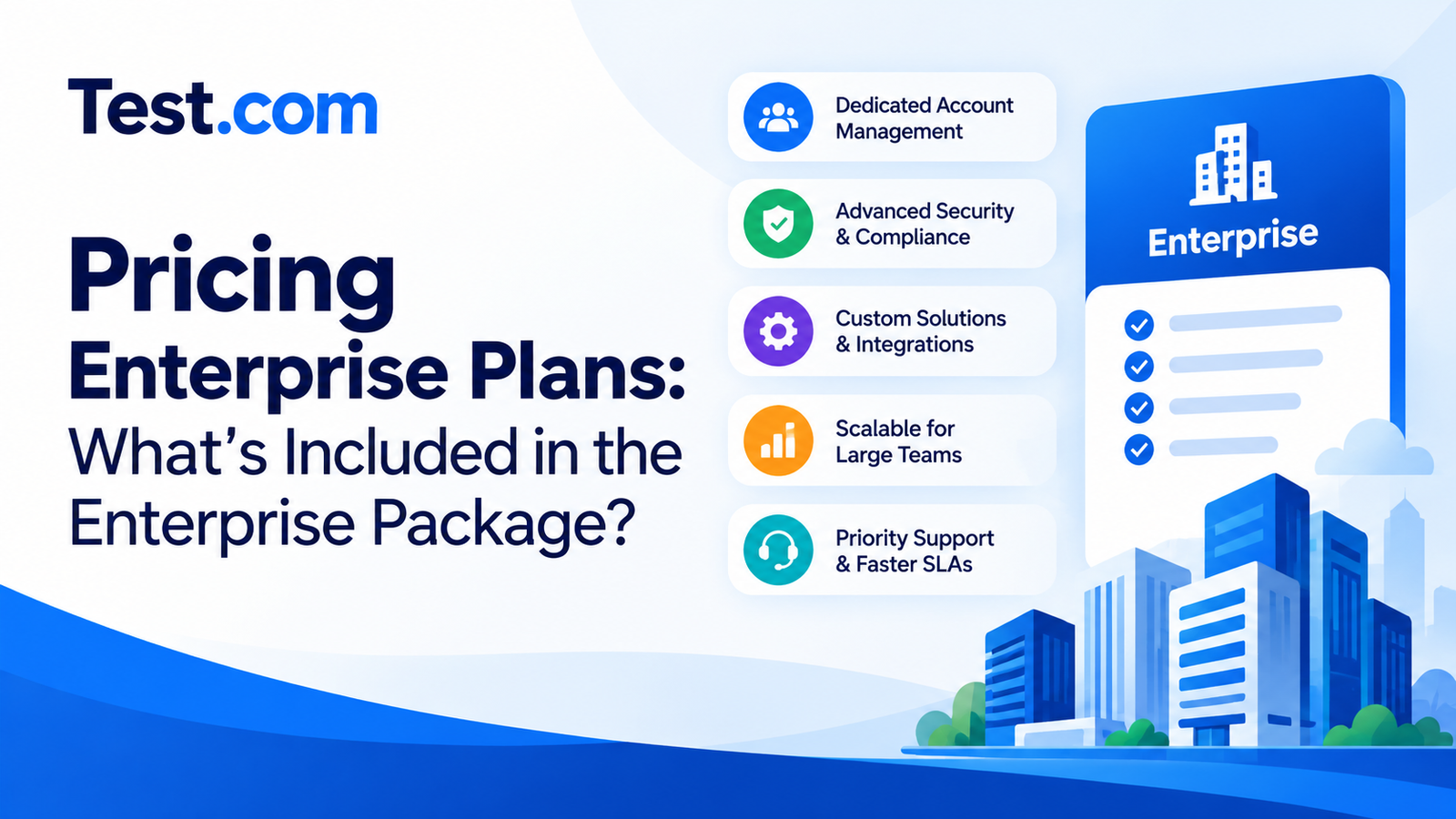
Test.com Pricing Enterprise Plans, now branded as Gauge Online, lists Enterprise pricing starting at $10,000 annually, plus $1,000 for annual hosting and a $2,000 one-time setup fee. Those published components total $13,000 for the first year, but this is a starting calculation rather than a guaranteed quote. Enterprise highlights certification and badging, proctoring integration, lessons, eCommerce, and developer tools.
For readers researching test.com pricing enterprise plans, the key is understanding how these starting charges relate to actual testing volume. A useful comparison must also distinguish included software capabilities from services charged separately, particularly supervised exam sessions.
This guide explains the package, the pricing questions that remain, and how to evaluate a proposal against your organisation’s needs.
What Is Test.com, and Why Does Its Pricing Appear Under Gauge?
Gauge is the online testing and certification platform associated with Test.com, Inc. The company’s official timeline records its rebranding as Gauge in 2020. Its focus is professional testing and credentialing, including programmes where exam results determine whether someone receives a qualification or certification.
That explains why searching for Test.com pricing leads to Gauge Online. When requesting information, use the Gauge product name and describe your assessment programme clearly.
For example, a trade association issuing professional credentials has different requirements from a business running occasional staff quizzes. The former may need identity checks, controlled exam access, certificates with expiry dates, and records that can be reviewed later.
Test.com Pricing Enterprise Plans at a Glance
Gauge publishes Professional and Enterprise options with the following starting charges.
| Published charge | Professional | Enterprise |
|---|---|---|
| Annual software starting price | $750 | $10,000 |
| Annual hosting | $250 | $1,000 |
| One-time setup | $500 | $2,000 |
| Calculated first-year starting total | $1,500 | $13,000 |
| Software plus hosting in later years* | $1,000 | $11,000 |
Calculated from the published starting components, assuming unchanged prices and configuration. These figures do not establish your final usage allowance or total contract cost.
A written proposal should explain exactly what the annual payment purchases. Ask for the included test allowance, enabled modules, additional service charges, and the treatment of usage above your estimate.
How Does Volume Pricing Work?
Gauge positions Enterprise for programmes exceeding 10,000 tests annually. Its Enterprise page describes volume pricing starting at $3 per test, with lower rates as volume increases.
However, the public presentation does not clearly reconcile that per-test rate with every component of the advertised annual starting price.
Do not automatically add $3 per test to the annual software fee, or assume all testing is covered by the minimum. Request one consolidated calculation showing how the quoted rate, annual commitment, hosting, and setup fit together.
This clarification prevents both underbudgeting and accidentally counting the same charge twice.
What’s Included in the Enterprise Package?
The package combines assessment delivery with tools for managing the wider certification process. The practical value depends on which parts of that process your organisation needs.
Advanced Exam Creation and Delivery
Gauge’s testing documentation describes six question types: multiple choice, matching, sorting, true/false, text answer, and Likert scale. It also supports question uploads, section-based exams, and configurable assessment rules.
Administrators can control time limits, attempt limits, passing scores, question randomisation, and scoring settings.
During a demonstration, bring a real sample exam. Check whether the system reproduces your scoring approach and candidate instructions correctly. A feature list alone cannot show whether a complicated assessment will behave as intended.
Certification, Badging, and Lessons
Gauge’s module documentation describes custom certifications, digital badges with QR codes, and expiration dates. Its Lessons module supports training content with progress tracking for individual users.
These capabilities matter when passing an exam is only one stage in a programme.
For example, you may want candidates to complete learning material before attempting an assessment. Afterward, your team may need to track which credentials remain valid. Ask the demonstrator to walk through that complete sequence, including an unsuccessful attempt and an expired credential.
Proctoring Integration
Proctoring integration and proctoring sessions are different purchases.
Gauge’s support documentation separates connections to existing proctoring providers from its proctoring service, which is sold per use. It lists services involving ProctorFree, MeazureLearning/ProctorU, and MonitorEDU.
For budgeting, establish:
- Which supervision method your exams require.
- Whether candidates or your organisation pay session charges.
- How retakes and rescheduled sessions are charged.
- Whether an existing proctoring agreement can be used.
An included connection does not establish that unlimited supervised exams are included.
eCommerce and Candidate Payments
Gauge’s product tour describes Stripe and PayPal Express Checkout connections, shopping-cart functionality, coupons, and payment settings. These tools allow organisations to charge candidates for assessments or other content.
Ask to see the checkout process from a candidate’s perspective. Test the purchase of one exam, multiple items, and a discounted registration.
Also request a clear breakdown of any payment-related costs. Access to eCommerce functionality should be evaluated separately from the commercial terms of your payment provider.
Developer Tools, Integrations, and Branding
The Enterprise offering describes REST API access, webhooks, single sign-on, and custom CSS and JavaScript controls. These support connections with existing systems and adjustments to the platform’s appearance.
For a technical evaluation, identify the records that must move between systems. That might include candidate registration, eligibility, exam completion, or results.
Then establish who builds and maintains each connection. Having access to an API does not, by itself, define the scope of implementation work included in your proposal.
Security and Administrative Controls
Gauge describes custom authentication, IP restrictions, user-group permissions, and exportable audit trails for Enterprise programmes.
Turn those descriptions into practical demonstration requests. Can one administrator see only their department’s candidates? Can your team retrieve a record of a particular administrative change?
If your organisation requires specific security documentation, request it directly and have the appropriate internal team review it before purchase.

What Can Affect the Final Cost?
The most useful budget starts with your programme’s actual activity.
Exams, Retakes, and Lessons
Gauge’s activation instructions ask customers to estimate the live tests and lessons expected during their first 12 months. The same guidance states that usage exceeding the prepaid amount may result in additional billing.
Count expected activity rather than relying only on your number of registered users.
As an illustrative planning example, 2,000 candidates taking three exams each would generate 6,000 exam attempts before retakes. Ask Gauge which activities count as billable usage and how unused capacity is treated.
Migration and Implementation
Prepare an inventory of the material you need to move:
- Question banks and associated media.
- Candidate accounts and identifiers.
- Historical results.
- Existing credentials.
- Connections to other business systems.
Ask the vendor to specify which items are covered by setup and which require additional work. Agree on acceptance checks, including sample records and exam results, before setting a launch date.
International Requirements
For a programme operating across countries, confirm invoicing currency, applicable taxes, candidate payment options, support hours, and the languages needed for your workflow.
Also test the experience from the locations where candidates will sit exams. A successful demonstration by an administrator does not replace checking the actual candidate journey.
Professional or Enterprise: Which Should You Choose?
The right decision starts with programme requirements rather than company size.
Professional deserves consideration when your testing needs are limited and you can select a smaller configuration. Enterprise warrants closer evaluation when assessment volume, integrations, and administrative requirements make a broader package useful.
Create a simple comparison with three columns: required capability, demonstrated behaviour, and quoted cost. This prevents an attractive feature list from overshadowing a missing requirement.
For instance, a large employer running a small annual quiz may have simpler needs than a smaller association managing several professional credentials.
How to Evaluate a Demo and Quote
Gauge advertises a 30-day trial without a credit card. It also states that billing is annual and cancellation is available without a long-term commitment. Clarify cancellation timing and refund terms before paying.
Use the evaluation period to run one complete workflow:
- Import a representative set of questions.
- Configure scoring, timing, and attempt rules.
- Register a sample candidate.
- Complete the assessment and review its results.
- Test credential delivery and any required integration.
Request a final proposal that names every included module and separates recurring charges from one-time services. Keep the demonstrated configuration alongside the proposal so both describe the same system.
Conclusion
Test.com’s Gauge Enterprise package brings together testing, credentialing, learning content, payment tools, and integrations. Its published starting charges provide a useful reference, but they do not replace a programme-specific quote.
Before choosing a package, confirm how annual fees and volume pricing interact, separate proctoring services from integration access, and test your complete candidate journey. Request an itemised proposal based on your expected annual activity to make the final decision with a clear budget.
You may also read